The growth in the uptake of, and interest in, strength and hypertrophy training has been fast since I picked up my first dumbbell 7 years ago.
Indeed, my 87 year old mother has recently started to accept my strength training (and muscle-building efforts) as a good thing in a way that she didn’t before. She is now proud of my dedication and asks every time I see her if I have been down to the ‘leisure centre’ that day. She also doesn’t ask me so much these days, as women in her generation were conditioned to do, how much I weigh at the moment.
One can easily tell when something has jumped to inter-generational acceptability when the Daily Telegraph (my mother is a subscriber) starts saying it is a good idea. And they have been espousing strength training for both women and men recently.
By now, most of us are aware of the benefits of having, and keeping, muscle. When I am out and about people now talk to me about their training, and mine, in a way that is extremely cool and it’s so nice to hear that everyone is ‘at it’ in some form or other.

Katy M. O’Brian in Love Lies Bleeding
Photo by Anna Kooris/Anna Kooris – © Crack in the Earth LLC
When I saw the film ‘Love Lies Bleeding’ this month, where one of the main characters was a female bodybuilder with an aesthetic which was clearly based on my original hero Lisa Lyon, it was amazing, but it also felt in a way surprising, arresting even, to see an incredibly muscular woman on the big screen.
Why surprising?
After all, as my coach Chris Allen, pointed out, muscularity in women which may have been frowned upon previously, is now absolutely mainstream. It’s almost the new orthodoxy.
Or is it? Maybe not on film. Or yet in public art.
Lisa Lyon died in 2023 and the fictional film Love Lies Bleeding is based in the 1980’s shortly after she won the first Women’s World Pro Bodybuilding Championship in 1979. I am interested in the 40+ year gap here, between the original and the fictional depiction, and what we have had in between.
The film’s Director, Rose Glass, stated that portraying a female bodybuilder was, ‘visually, it seemed very striking territory. But it also felt psychologically potent and interesting.‘ The character in the film was aiming to become statue-like, and this muscularity in a female still seems ‘a subversive act’, according to Glass in an interview with Big Issue, “There’s just so many more complicated and often negative reactions associated with female muscularity. Male muscularity is celebrated. Female muscularity still shocks some people.”
If female muscularity is the new orthodoxy, why did I still feel such a thrill at the ‘newness’ of seeing this on screen?
We have had physically strong female characters on film of course (Sarah Connor, Ellen Ripley etc) but possibly nothing compared to the sculptural representation of Katy O’Brien in Love Lies Bleeding.

In terms of acts of subversion, in the 1980’s Lisa Lyon herself posed as a classical (male) statue for photographer Joel-Peter Witkin (above).
Personally, I took inspiration from the actual Lisa Lyon pretty soon into my fitness journey when I first read Patti Smith’s memoir, Just Kids, (Patti Smith is an ultimate badass in a completely different way) which introduced me to the work of Robert Mapplethorpe, the photographer with whom Lisa Lyon first worked. And Lisa Lyon physically embodied the strong and female in a way that I found very inspiring and it’s interesting to see her lasting appeal as a muse for this film.
Contrast this with a recent visit to the Ashmolean Museum in Oxford where I love the classical statues but I was now looking afresh at the fact that the women were mostly clothed and the men had the glutes of which any modern female interested in muscle-building would be proud.
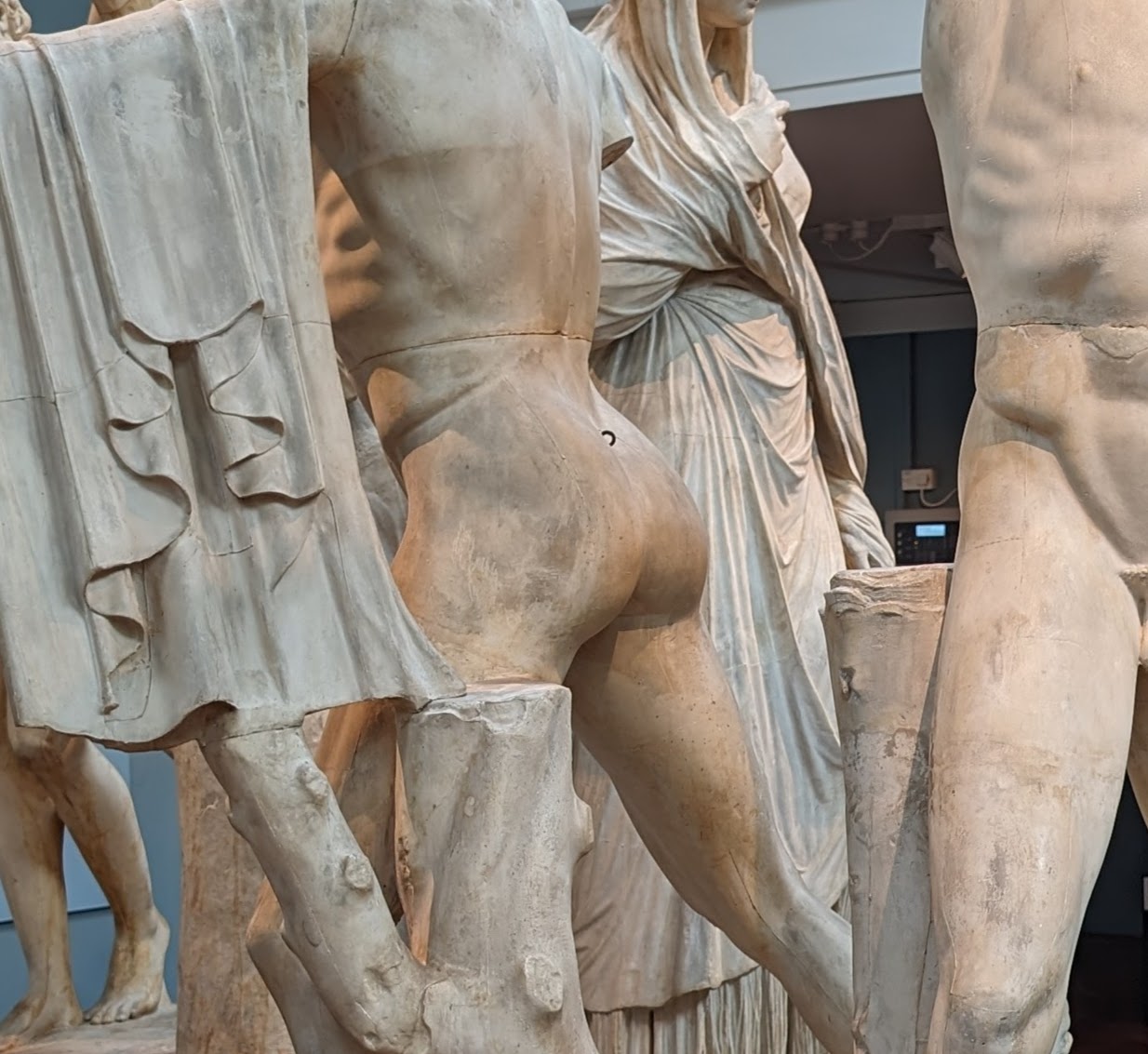
Detail of clothed female and unclothed male classical sculptures in the Ashmolean Museum from my recent visit
Maybe it’s this ubiquity in our external surroundings of the soft feminine and the strong masculine from our cultural history that still makes a strong woman on screen feel somehow so new/different.
But does it even matter, after all everyone in our western society will surely be used to seeing defined female musculature by now?
Cut to the European Athletics Championships this month and again I was interested in the visual imagery here as the statues were front and centre in the Stadio dei Marmi . They looked in a way very modern, were all of muscled men, and they were ++ in terms of their muscular development.
When I looked into it I wasn’t quite sure how to feel about these sculptures which, it turned out, were depicting the ‘masculine ideal’ from Italy’s fascist past and which were now at the centre of the modern games (individual examples of the sculptures here).
Perhaps the photographic images I saw of current, living, female athletes in front of the sculptures were actually the strongest statement – let’s celebrate female athleticism now, as well as male, and how far we have come with that, even in just 100 years.
Meanwhile, I’ll continue with trying to develop all the muscles I can name (it’s a slow business), and enjoying my regular visits to the ‘leisure centre’ (bless my lovely mum) as much as I can.

Trying our hardest to be muscular – Steph, and Me, doing some benching
Enter your email below to subscribe to Project: Badassery:

 Project: Badassery